
C–N Bond Formation Through Hydrogen Borrowing
Abstract
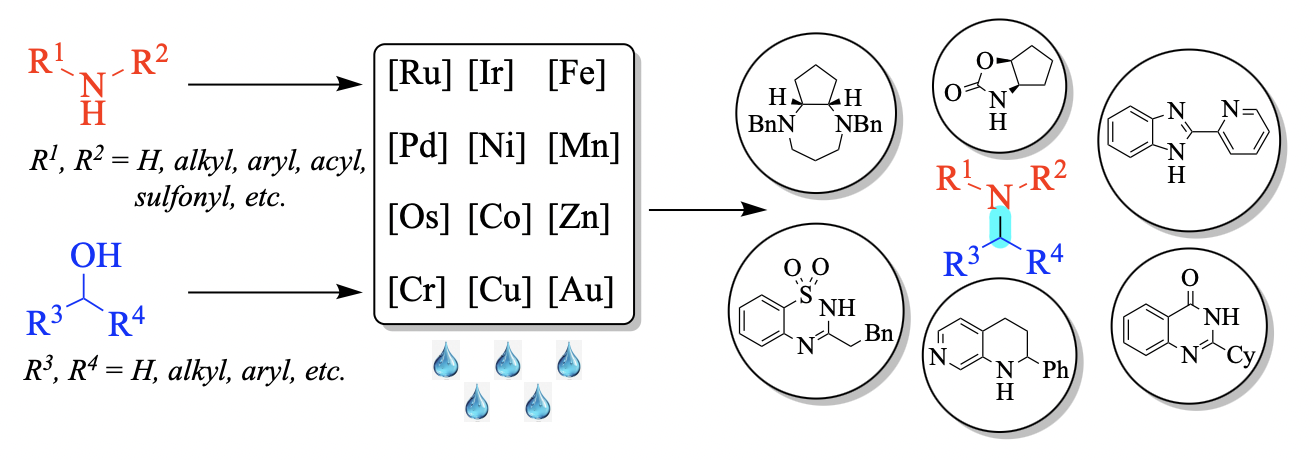
Hydrogen-borrowing amination is a metal- or enzyme-catalyzed N-alkylation process that uses alcohols as alkyl transfer agents. In this reaction, alcohol dehydrogenation affords a carbonyl compound, which then undergoes condensation with an amine nucleophile. The imine or iminium salt product is subsequently reduced by a metal hydride generated during the preceding dehydrogenation step. This methodology is a green alternative to classical C–N bond-forming reactions such as nucleophilic substitution and reductive amination. Hydrogen-borrowing N-alkylation is an atom economical, cost-efficient, and environmentally benign method, making it an attractive approach for the preparation of amines and nitrogen-containing groups. Continued development of these reactions has enabled the preparation of challenging substrates, and facilitated tandem and multistep reaction sequences, mainly promoted by ruthenium- and iridium-based catalytic systems. This chapter describes the history, mechanism, stereochemistry, scope and limitations, and synthetic applications of hydrogen-borrowing amination reactions. The tabular survey includes extensive coverage of coupling reactions that use a variety of nitrogen nucleophiles (i.e., ammonia, higher amines, heterocycles, acyl hydrazides, amides, iminophosphoranes, nitriles) and alcohol electrophiles.