

The Nazarov Reaction: 30 Years of Progress
Abstract
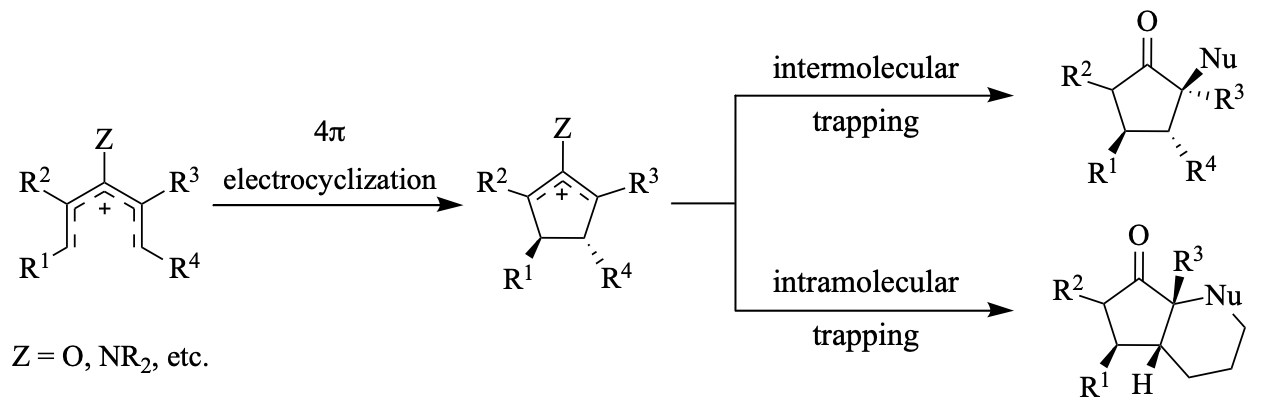
The traditional Nazarov reaction is the conrotatory 4π electrocyclization of conjugated pentadienyl cations, which are derived from Lewis or Brønsted acid activation of 1,4-pentadien-3-ones. This reaction provides an expedient way to assemble carbocyclic products from simple, acyclic starting materials; however, reaction conditions often require at least one equivalent of a strong acid to facilitate cyclization, and the regioselectivity of the standard eliminative termination step is difficult to control.
This chapter describes advances in Nazarov methodology since it was last reviewed in Organic Reactions in 1994. The discussion is focused on the preparation and use of alternative substrates to access the requisite pentadienyl cation as well as methods to induce cyclization with new and asymmetric catalytic systems. Also presented is a discussion of the interrupted Nazarov reaction, which utilizes both cationic and enolate intermediates to form new bonds or to initiate cascade or tandem reaction sequences. Both inter- and intramolecular interrupted Nazarov reactions generate highly functionalized products, some of which may possess four contiguous stereogenic centers. Trapping events can involve heteronucleophiles, π-systems, or structural rearrangements, which occur in a stereocontrolled fashion.