Catalytic Atroposelective Aryl–Aryl Bond Formation
Abstract
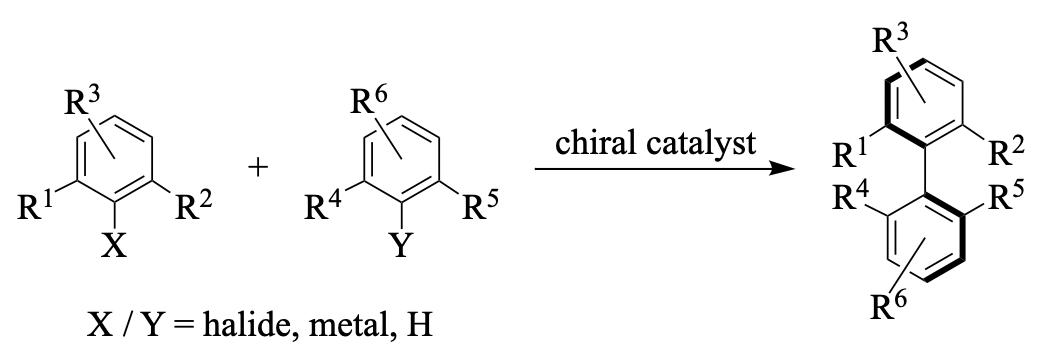
Atropisomeric biaryl compounds are prepared by coupling two aryl partners in the presence of a chiral catalyst. When these biaryl products contain three or more substituents adjacent to the new aryl–aryl bond, the barrier to bond rotation becomes sufficiently high to enable the isolation of single enantiomers. This structural feature is found in numerous natural products and chiral ligand frameworks.
The asymmetric catalytic construction of a carbon–carbon bond between two sp2-hybridized aryl fragments can be achieved with redox-neutral cross-couplings, reductive homo-couplings, couplings through C–H activation, oxidative couplings, and couplings by nucleophilic addition to oxidized partners. Although considerable emphasis has been placed on traditional palladium-catalyzed cross-coupling reactions, including asymmetric Suzuki coupling, there have been significant advances in both reductive and oxidative approaches. Functional-group tolerance on the coupling partners is varied and often dependent on the choice of chiral catalyst and ligand. Where appropriate, mechanisms and proposed stereochemical models are used to explain the observed axial chirality. These transformations are showcased in the syntheses of natural products and novel chiral ligands.
The goal of this chapter is to demonstrate the significance of catalytic atroposelective aryl–aryl bond-forming reactions, including the continued development of catalytic systems to achieve excellent yields and enantioselectivities. Additionally, some less-common approaches towards catalytic atroposelective aryl–aryl bond formation are discussed.